Showing posts with label Flats. Show all posts

Monday, June 10, 2019

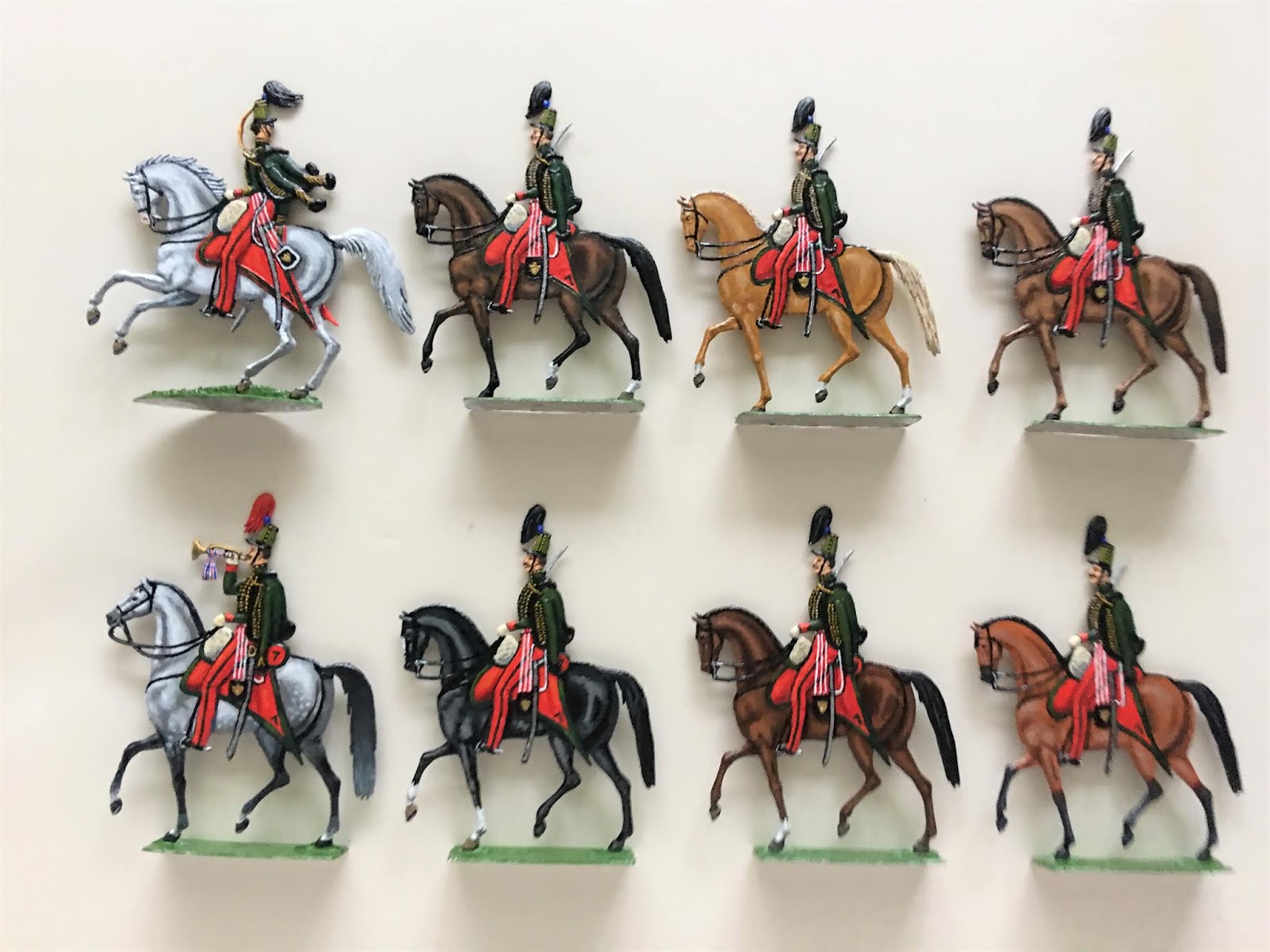
French Husssars of 1845 - 45mm Flats


Here's another set of antique Heinrichsen flats, # 6023 which was first issued in 1845.  They're from the 60mm range but as all the horse I've gotten in this size are undersized relative to the foot (which are true 60mm, I think that's good thing because they match other figures I already have.

The castings were clean but the detail was a bit understated, so care had to be taken not to put down the paint too thick.


Researching the uniform colors was fun.  I relied heavily on Lienhart & Humbert but as mostly the saddles are depicted as the sheepskins, it took some digging to find the shabraque. I eventually found an image for the 7th, so that's how I painted them.


With plenty of detail to paint, they took me several weeks to complete.


Tuesday, April 9, 2019

Wooden Flats - Part 2


In the previous post I shared with you my discovery of wooden flats from Russia.  Now we can look at cavalry and artillery as well as further evolution of the designs to include outlining.

These lancers are quite nicely animated.  However, the targeted scale of 45mm to the eyes was overshot as the calculation for the cavalry didn't take into account that a charging rider wouldn't be standing straight in the saddle.  The figures are closer to 1/35 and wouldn't look out of place in a 54mm army.  So I just test painted a figure as the 17th Lancers.


As with the French infantry, the figures are blanks and thus also where and how to paint the details is up to the painter.  In this case I chose to rotate the rider's torso somewhat.

For the next order, I asked Yevgeny if he could add plumes to the lancers for a bit more of a Napoleonic look. He obliged by not only doing that but adding outlines to the figures as well as posing them differently.  And we downsized everything to 42mm in order to match up better with the Nowikoff home casts.


The rider has been reduced in size but to my eyes the horse came out a bit elongated. Or perhaps it's the shabraque, or both ?   Regardless, it's still a vigorously posed and pleasing figure.  The outlines definitely simplified the painting (or would have had I not chosen the gaudy Red Lancers) although how much or little detail to give the horse is still up to the painter.

And lastly, Russian styled artillery for the Kingdom of Novgorod.


I quite like the design of this cannon as the three part assembly of gun barrel and wheels adds a surprisingly good illusion of depth relative to a completely flat gun.

Hope you enjoyed viewing these.  The painting has been challenging but quite rewarding.

Thursday, March 14, 2019

Wooden Flats - Part 1


Here's a unit I recently finished.  These wooden flats are from Russia, 45mm to the eyes.  They're for my imagi-nations war of ca. 1820: Celtican infantry, le 7eme de Ligne.

The figures start like this.  Wooden blanks without detail.  Thickness is 4mm at this scale.  Definitely a painting challenge as where to place the details is a matter of estimation.


And painted.


I did a bit of shading but not at the edges.  As the thickness means they're almost semi-round when viewed at an angle, edge shading does not work as it does on a conventional flat.  And I gave them toy soldier faces from the front.


Next up, cavalry and artillery.

Wednesday, February 20, 2019

Heinrichsen Infantry - 45mm Flats


Finished painting this unit last week. Antique Heinrichsen flats, 45mm to the eyes. This is kind of a one-off set, purchased when Heinrichsen was cleaning out old inventory mid-2017. First issued 1840, they represent French troops ca. 1830.
For my 1820's imagi-nation of Celtica, I took a few liberties such as the ficticious grenadier flag. But they are plausibly French enough to sell as such when the day comes. 24 soldiers came in the box, I did not paint the extra sapper and trumpeter.
As you can see from the command figure grouping, I almost completely dispensed with the shading. Started out that way, but they are so slender that shading only accentuated it in a bad way, so I painted them more in straight toy soldier fashion.


And in closing, a rather comical stylistic mismatch with some wooden flats which I am currently working on. More about this latter to follow soon.


Thursday, January 10, 2019

Heinrichsen Flat Cavalry - 45mm


Here's a squadron of cavalry I just completed, 45mm flats. Heinrichsen set # 6017, Pruess. Reitende Artillerie 1830. The designs date to 1845. Nominally they are supposed to be 60mm. But with these old figures, the cavalry are smaller than the foot. Suits me fine because they fit my ca.1830 project perfectly.  Stylistically, as you would expect from their antique nature, they are somewhat toylike. But to my eyes all the better for it.
It's interesting that they're sold as horse artillery, but as there's a corresponding set with caisson & gun, perhaps they are meant to be outriders ? Practically speaking they work fine as any light cavalry, and the painting guide also shows them as Englische Dragoner. I painted them as Prussians, but they'll serve quite well for the bellicose army of der Grolshken Reich.
The command.
Sample troopers.
And a parting shot.
There's also another trumpeter which I did not paint.  I'm saving him for conversion to a standard bearer, although soldering will be required.  Something I have no experience with, but then how hard can it be ?  😉

Sunday, December 23, 2018

Renaissance Flags - 30mm Flats


Let's take a look at two standard bearers which I have recently completed.  They're for my formations of mercenary reiters and later landsknechts.   I entered into this phase of the project with some trepidation as painting flags can be tricky.  My period for these is ca. 1550-1580, give or take a decade.  That aligns with the French Wars of Religion and first half of the Dutch Revolt.  And there's always the option of imagi-nations, but getting too fantastical will decrease the appeal of the figures should there be a reason to sell them later.

It seems that while the Imperialist, Spanish, Dutch, and for France the Royalist & Huguenot flags are at least somewhat known, for mercenary Germans of this period, I have found almost nothing.  Thus my avenue of approach.  One source could be the Triumph of Maximilian which illustrates a number of banners.  And while the old Dover edition of b&w woodcuts is a work of art in its own right, the colored version is absolutely glorious to behold.


From this illustration I copied the goat rampant, hoping to at least avoid having him turn out like a crazed rabbit.  And the red banner was used previously for the 45mm landsknechts, I got good mileage out of this page. For the infantry, this German flag card from the 1930's served as the basis for my design.


Taking on the diamonds would have been madness, but the stripes ?  Okay, let's do it !  On my figure, the flag is very close to 40mm in height where it attaches to the pole.  Thus eight stripes of 5mm each would work out. The thought of how to pull this off credibly with a flag that's tapered from the "front" side of the figure was intimidating. In the event, things went well enough but it was one of the harder things I've attempted.

So how did they turn out ?


I'm happy with the result.  On the landsknecht flag, I didn't bother with attempting full-on connoisseur ripple effects as he's meant to serve as a fighting soldier with no aspirations of  being a modelling contest entry.  And one final "action" shot.  I didn't paint all these figures, bought some already painted on eBay.  I doubt I'll bother trying to rework them, whoever painted them did a nice job.


In parting, I wonder about these giant banners. Perhaps the size is exaggerated for effect, but from period illustrations they do appear to be quite large.  Even though probably made of light weight silk, the effort of holding all that mass aloft one-handed with a metal spike atop, it must have taken a strong man, particularly on a windy day.  And how did they keep it from getting tangled amidst the forest of pikes ?   Perhaps a Renaissance warfare expert can weigh in.


Monday, November 19, 2018

Back in the Saddle Redux


Wow, it's been nearly a year since the previous post.  A lot has happened. I retired at the end of July.  In August, we moved to a city out past Sacramento where the rent is cheaper and most of the kids & grandchildren live closer.  Nice town too, with enough hills to make the road cycling more interesting.  Haven't found much for the mountain bike yet, but sooner or later I hope to discover some good trails.

Work ?  Except for the people, don't miss it a bit !  Although I do have recurring and mildly disturbing dreams in which I'm still working the same type of job.  Hopefully, like dreaming of cigarettes after one has kicked the habit, they will eventually subside.

And after a long hiatus, I have resumed painting.  Finally all the paints and supplies are out of storage.  I've set up a nice workspace in the garage which fortunately has a window which lets in a good amount of natural light.  Getting somewhat cold out there now but still tolerable.


So what do we have here ?  This is a 40mm Renaissance knight ca. 1500 from Heinrichsen Zinnfiguren.  Nice old flat, the original set of landsknechts were issued in 1885.  He is casting # 46 in the series and about the only suitable mounted figure in the set. I bought the casting as a one off from Jim Horan a few years back and just got around to painting him.  I understand from Dr. Grobe of Heinrichsen that the mold is damaged, so for better or worse my paint job will have to suffice.  Here are a couple more close-ups.


What next ?   I recently stumbled across some interesting 40-45mm semi-flats (with emphasis on the flat) made in Russia.  All told they are 32 different for the Italian Wars.  They're somewhat crude, but still appealing and match well for size with Meisterzinn.  I got 24 and will post in groups of 8.  But here's a taste.


Saturday, March 18, 2017

Brandenburg,1690-1700: 30mm Flats


For a change of pace from the Lego figures, here's a few flats for the Nine Years War period.  These I painted recently.

First up, infantry.  Pikemen and musketeers from Kieler, brilliant figures engraved by a master, Ludwig Frank.


You may have noticed the musketeers are not as crisply cast as the pikemen. I got the latter on eBay years ago and I've often wondered if they were pirated castings. Not Spencer-Smith caliber vague surely, but they do call for some estimation of  how to execute the details once the paint goes on and further obscures what lies beneath.

And as painted. As always, with acrylics.


And a couple of mounted figures.  Left casting is Scholtz, the in-house line sold by Berliner Zinnfiguren,  On the right, a Kieler dragoon.  An Austrian judging by the canteen on the other side, I like him better but I have only this one.  The dual tail on the Scholtz horse is a nice touch, adding a little variety to your formation depending upon which way you cut. I wish they'd done likewise with the hat brim.


And the Scholtz figure as painted.  These actually belong to a set, The Great Elector Landing on Rugen Island, 1678.  Which, as usual for Berliner Zinnfiguren is pricey.  I don't have it, bought enough at a reasonable cost from Alexander Wilken to paint a smallish squadron.  In the military fashion sense they bridge the gap between the 30 Years War and the War of the Spanish Succession but can pass for 1690-1700.


Not my best painting with all these, but certainly adequate for standing in a battalion or squadron.  Next up, I have finished the Lego minifig grenadier and cavalry trooper.  These turned out nicely and I'll post them shortly.

Tuesday, December 29, 2015

The Battle of Fort Panion - Part 3


This post will encompass the final three battle turns with a final recap.With a lot to cover, let's get started.

TURN 4:   Aquilonia wins the toss, Moves first.

Move:

Aquilonia: Heavy infantry double move.
Argos: Stand pat.

Fire:

Argos: The Fort Panion Slingers fire effectively against the Eruk infantry as they approach melee range, killing Prince Tiglath in the process. And the 1st Peltasts add to the mayhem striking down another 4, the Shemites ranks already shrinking before they can come to grips with the peltasts. The 3rd Peltasts somehow stand firm but miss Achilles.

Aquilonia:  The Tanasul Archers focus their fire on the 2nd Messentian, killing just one. The Elephant archers aboard Jumbo fire into the backs of the retreating Messentians killing another as do Achilles and Ajax against the Argive Guards.

Melee:

On the Aquilonian right, it finally dawns on dim bulb Prince Alkestis that he's led the Young Companions on a death ride in rashly taking on the full power of the Turanian cavalry.  Reduced to a few bloody and exhausted troopers, they're wiped out by the Shahpur Light Horse.


Meanwhile the 2nd Royal Guards close against the Samaran Horse, wasting the advantages of impetus and superior armor with a mere 2 Turanians killed vs.2 of their own. They've squandered their slim window of opportunity.

"The Guard dies, it does not surrender !"
On the opposite flank, the Guards fight on, somehow keep beating the morale tests for overwhelming odds but like the Young Companions, seem unlikely to survive much more of it.


The elephants continue their rampage against the Argive foot.  Jumbo squashes another 5 of the routed 1st Messentian. Fighting stoutly, the Foot Guards lose 2 men but succeed in hamstringing Achilles and Ajax who collapse to the dusty earth trumpeting their agony.  

And what of our commanders ?  Bardikkas, observing that things go badly for his cavalry on the right flank, rides to the Tanasul Archers:


Bardikkas: Philocrates, it goes hard for us on the right. Hasten your archers there, at the double. Should the Turanians break out and attempt to flank our foot, shoot them down !    


Memnon, his horse frantic from the alien smell and trumpeting of the elephants, barely controls his skittish mount with a firm hand and removes himself to Fort Panion Hill.


The situation at the end of Turn 4.  

TURN 5:  Aquilonia retains the hot hand, again moving first.

Move:

Aquilonia: Seeing the 1st Messentian are finished, Jumbo's mahout swings him right to attack the 3rd Peltasts. In the center, all heavy infantry moves into melee.  The Tanasul Archers forgo firing and as ordered, make their double move towards the right.

Argos: Throwing away their shields to make better speed, the survivors of the 1st Messentian flee the battlefield, carrying Iollas along with the tide.

Fire:

Argos:  The 3rd Peltasts continue their record of futility against the elephants, Ajax making a saving throw on the hit.  But their counterparts on the hill fare much better, the 1st Peltasts killing another 5 Shemites just before they close to hand-to-hand combat.

Aquilonia: Jumbo's missile crew fail to score against the 3rd Peltasts.

Melee:


The Argive Guard cavalry go down fighting to the last man against the Daramish Light Horse.


 On the opposite flank, facing two units of Turanians, the Royal Guards suffer another 3 casualties against only one inflicted.


In the shadow of Jumbo's looming bulk, the 3rd Peltasts fail morale check and rout from the battlefield.


With a mighty clash of iron and bronze, the elite phalanxes collide.  As the rules are silent about how sarissa-armed phalangites might fare against troops armed with swords or spears, I make a house rule: first round of melee only, pike armed troops do not take damage.  Thus the Foot Companions inflict 5 total kills on the Guards who repay them in the 2nd melee round with 2 kills, one being the phalanx commander Phillip.  But deputy commander Pallantides stands ready to attach himself to the Foot Companions.


Already unnerved by their losses in repulsing of the elephants and with the Foot Companions pushing them hard, the Guards fail morale check and retreat one move in good order.


In the center, the Aquilonian Mercenary Phalanx assaults uphill against the hoplites of the 2nd Messentian. They inflict casualties 4:2.


In front of the fort, the decimated Eruk Infantry attack with berserk fury, revenging themselves on the light-armed 1st Peltasts with 9 kills to 3 in return. Amazingly, the Shemites have nearly evened the odds,  But the peltasts pass morale test and gamely fight on, in the heat of battle forgetting the pre-battle orders to retire behind the Turanian cavalry and let the Shemites bite granite against the walls of the fort.

TURN 6:  Argos wins the toss.

Move:  

Argos: With the Foot Campanions relentlessly coming on and Jumbo looming up on their right flank, in order to preserver the core of Milo's army, the Argive Guards retreat from the battlefield in good order.


Aquilonia:  With no hesitation, Pallantides orders the Foot Companions to wheel right and prepare to ascend the hill, with the intention of rolling up the Argive line.  Jumbo secures their left in case of a change of heart by the Argive Guards.  Having finished the Horse Guards, the Daramish Light Horse gallop back towards the Aquilonian right with a double move.

Melee:

In the center, the Mercenary Phalanx continues to press the 2nd Messentian hard, inflicting 6 casualties to 3.


The yoeman performance of the mercenary Turanians being about the only bright spot for Argos this day, the 2nd Royal Guards are further whittled down to just Dion and a few troopers, who fly in the face of insurmountable odds.


The heavier armed Eruk Infantry continue to heavily punish the 1st Peltasts with another 5 kills for just two of their own.  Yet with the odds finally evened and the prospect at hand of being able to slay their tormentors to a man, the Shemites fail morale check and inexplicably break with victory at hand. In the foreground, Dion lives to fight another day.

CONCLUSION:


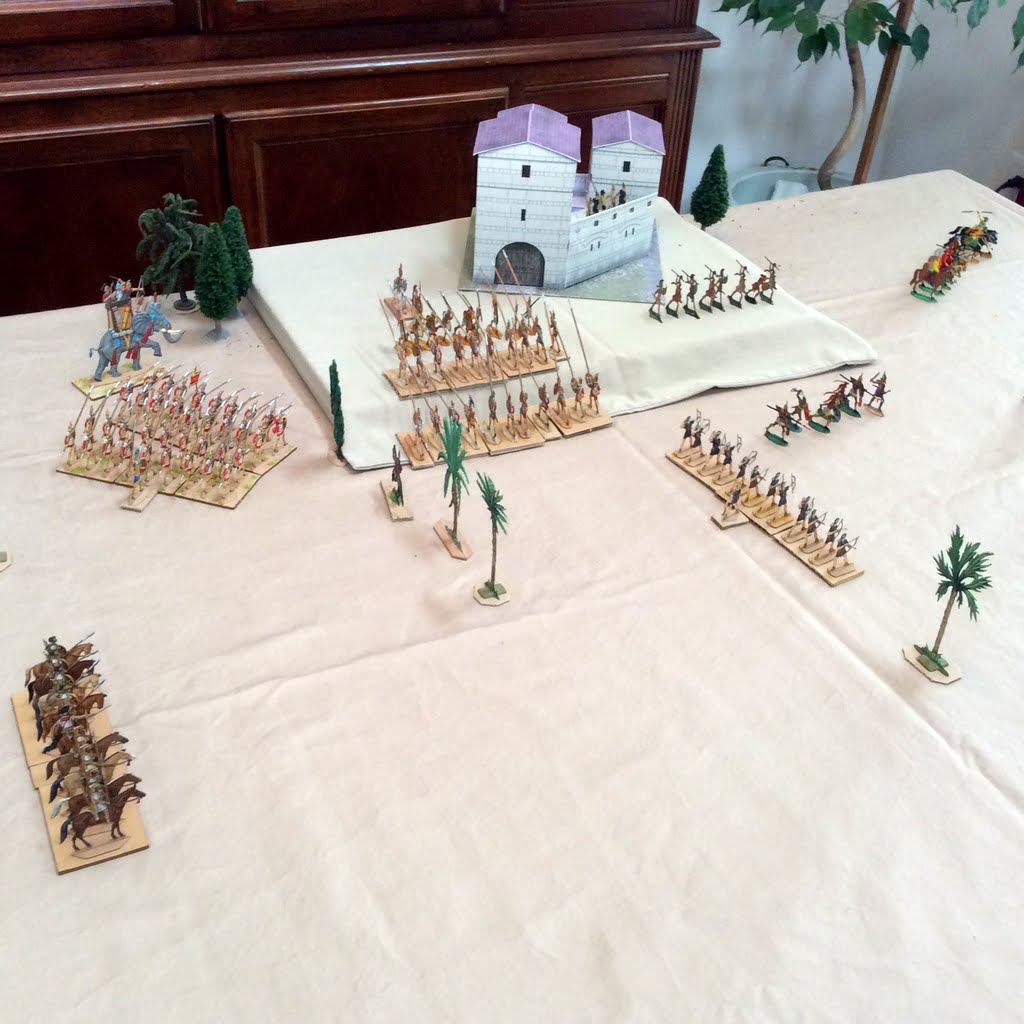
The situation at the end of Turn 6.  Although the Turanians and peltasts have seen off their enemies, the Argive right wing has been entirely routed or destroyed.  The Foot Companions threaten to flank the 2nd Messentian, and with the relatively fresh Tanasul Archers and Daramish Light Horse ready to reinforce, the day appears lost for Argos. Memnon decides to leave the miscreant garrison of Fort Panion to the tender mercies of Black Bardikkas and orders a retreat.

Thus a hard-fought victory for the forces of Aquilonia, King Epeus' punitive expedition has succeeded. Upon hearing from Pallantides that the garrison of Fort Panion has offered to surrender with the honors of war, Bardikkas snorts with derision: "Honors of war ? The knaves can die when I starve them of food or drink or they can die when our siege engines open a breach and we put them to the sword.  Tell them to surrender now unconditionally and I'll spare their lives".

Bardikkas remained true to his word.  The garrison was spared but stripped of everything and enslaved, brought back to Aquilonia in chains to serve out the rest of their shortened lives in misery working the silver mines at Pasentium.  Fort Panion itself is annexed by Aquilonia, the king opting to install a garrison of his own instead of pulling it down.

RECAP:

Although I found the melee conduct a bit fiddly, the rules in general seemed  straightforward and well suited to the action.  I did commit one blunder which had some impact on the battle.  For Turns 1-4, I somehow overlooked dicing for "contact morale" at the conclusion of each two melee rounds.  Awakening fresh for the second day's conclusion, I discovered my oversight before resuming with Turn 5. And although I diced for the rest of the contingencies such as overwhelming strength, it did play out in some heavily bloody cavalry fights with the right of the stronger prevailing without the wild card element of surprise, that is - the weaker side lifted up by an unlikely reversal of fortune.

I have to wonder, was the deck stacked against Argos ?  Perhaps I instinctively realized this in adding the mad charge of the Young Companions, but even so the power of the elephants in wrecking a large and small Argive unit as well as weakening another weighed heavily in the event.  Funny thing too, because I have several old painted Egyptian chariots, considered adding them to the army of Argos as a counterweight but did not.  I suppose I felt they were lacking that menacing Persian/Seleucid scythed chariot ambiance, but in a Hyborian battle, who cares really ?

To sum up, I enjoyed everything about this battle, organizing the armies, creating a back story, fighting it out, doing the photography.  What I liked most is that the thing kind of took on a life of its own once I started the troops in action.

Eventually I'll do this again and am looking forward to painting some new units to make the next battle a fresh spectacle for myself and blog readers.  I also have several terrific command figure castings in the Carl "Battle of Issos" set who will make suitably impressive generals. In any case, I hope you enjoyed this one.