Showing posts with label Prince August. Show all posts
Saturday, March 15, 2014
PA Cavalry Conversion 2: 40mm Home Casting
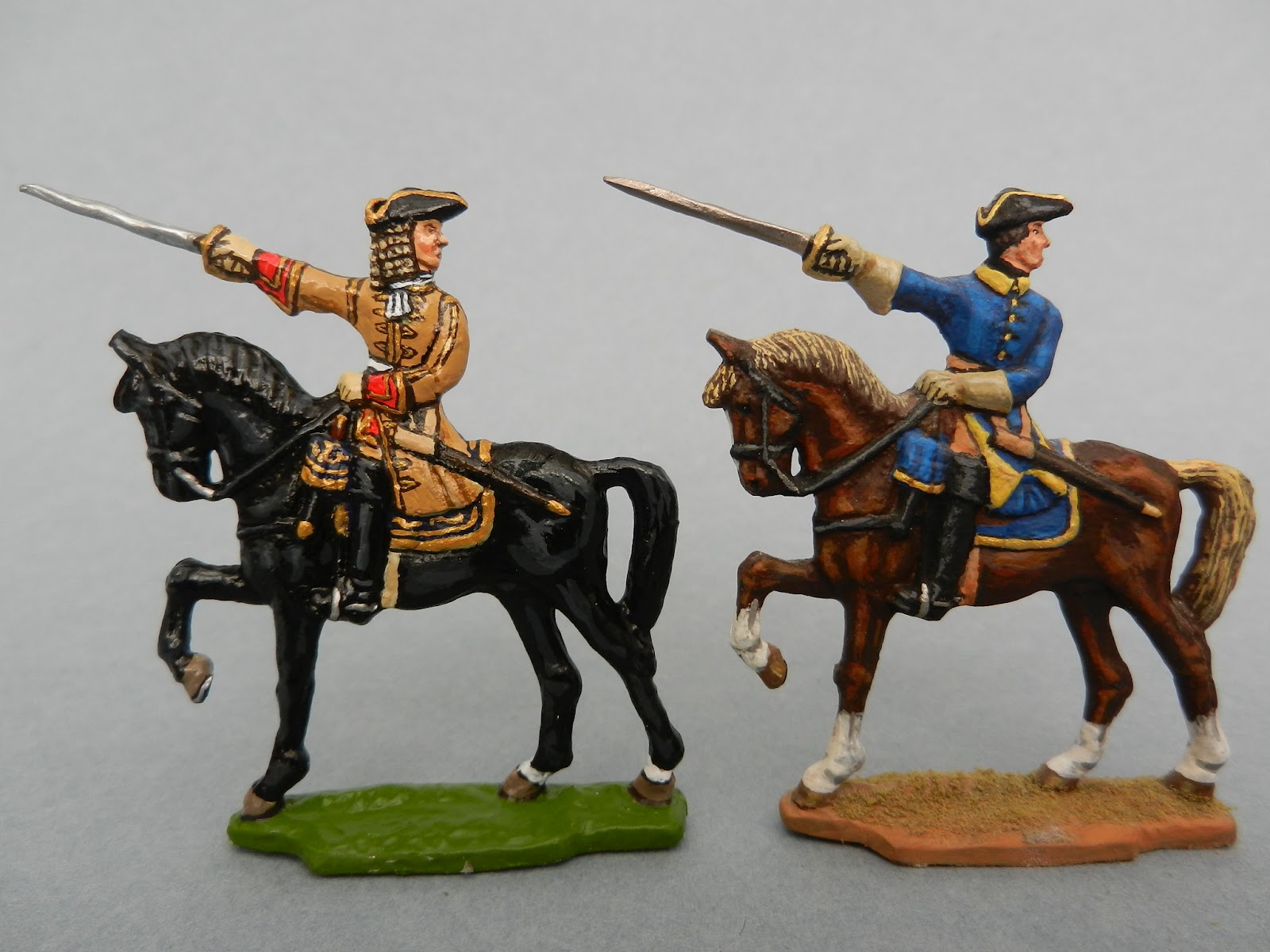
Finally got around to painting the first casting from the modification of the Prince August cavalry figure. Conversion on the left, original on the right:
The verdict ? I have mixed feelings about this. The horse and the rider's coat show minor improvements. But to my eyes, it looks like bulking up the hat was a mistake. In the abstract, it wasn't a bad idea to fix the rider's flattish tricorne. However I missed something when enumerating the figure's flaws: not only the horse's head is too big, so is the rider's. What I did here only accentuated it.
Still an okay figure but I'm not excited about it. May hold off for a bit to see what Prince August unveils in the new range of 7YW molds, hopefully some nice cavalry is in the offing.
Friday, February 21, 2014
PA Cavalry Conversion: 40mm Semi-Rounds
I had hoped to show more painted results of the latest figure conversion but had a setback in the mold making stage of the process, more about which later. For now, the story begins with Prince August cavalry. While we're relatively spoiled for choice with the infantry, there are four main cavalry trooper figures which can be cast. First we have good old PA11 and the identical pose in its newer, more fully rounded version:
This seems to be the hands down favorite, and we also see a very similar figure as the mainstay of everyone's Spencer Smith cavalry arm. I like this one but he looks very Swedish to me in style and the hell-for-leather charge was probably not the norm for most armies' cavalry doctrine of the era. And of course we have the pistol wielding PA48 and the nice, but rather static dragoon PA41.
Both these latter figures certainly have their uses, but sticking to sword-armed cavalry it comes down to Molds # 11 or Mold # 935 painted in his "Wild Geese" livery in the top photo. # 935 seems to be not nearly as popular, perhaps in part due to difficulty in casting the sword fully. Further, there are things about the figure which are not quite right. The horse's head looks oversized, the hind quarters a bit skimpy and angular, the pistols oddly mounted forward and too low on the body instead of up near the saddle. But I do very much like the pose, so let's see what can be done here:
As can be seen in the comparison shot, what I have done to the rider is bulk up the flattish tricorne, also give him a fuller coat and cuffs. I beefed up the sword a bit to get a stronger cast, with the intention of filing it after casting. The horse and tack get some attention as well: among other things, filed down the head a little, added more definition to the hind quarters, amputed the pistol holsters and replaced with green ones.
So far so good, I think. Last weekend I made a new mold with eager anticipation of casting and painting this new figure. The first half came out fine. Unfortunately, had a bit of a disaster where a small portion of the second mold have stuck to the first despite the use of mold separation cream. Evidently I missed a spot. And this damage fell right across part of the horse, ruining the castings. Why not just re-do the second half, you ask ? Good question ! And I would have done so but for the lack of sufficient RTV compound. Rather than taking the sensible course of ordering more and waiting, I tried patching the 2nd half, would up cutting extra channels in the original half as a work-around and to sum up, botched the whole thing. So we're a week or two away from seeing this figure actually painted.
In the meantime, I've also started on the infantry command figures. The standard bearer is finished, the drummer just under way. I'll soon show these in subsequent postings.
Friday, February 7, 2014
Transforming a Swede to a Frenchman - 40mm Semi-Rounds
I've often wished that Prince August could have done better of creating a French infantryman than the Battle of Rossbach mold PA58. Of course, there is also the "French Regiments of 1750" and "Wild Geese" series of molds. But they are very much a case of old wine in new bottles, Karoliners sold with painting guides as French troops. Of course, I painted a regiment of these years ago.
And a Swiss battalion Courten made from GNW molds. A little better, but still essentially Danes or Russians in disguise.
In any case, following up on the previous post, it was time to try something more ambitious. My objective was two-fold. First, I wanted a more convincing French infantry figure for my 40mm armies. Secondly, I wanted it in the always useful "march attack" pose. Did I have the sculpting talent to make one ? Who knows, and what were the chances of creating a tolerably good figure the first time out ?
Hedging my bets, I decided to use a PA casting as the base figure upon which to add green stuff to build up a suitable master. For this, I chose the advancing musketeer PA14, the hat company counterpart to the previously featured grenadier figure.
Again, this is one of the older, flatter Eriksson molds without precise detail. The idea was to substantially rework the figure, but take advantage of the good proportions and aggressive advancing stance. I cut off the weapons, amputated his arms and filed down the coat to a bare outline. I then started to rebuild the figure with green stuff. And here and there, I used existing bits from other figures such as the musket and scabbards.
My main worry was getting the arms to appear natural, hoping to hit a happy medium between T.rex and orangutan. That and just getting the general "look" right. And the new master.
It looked pretty good to me, but the proof would be in the casting. My 1st mold went wrong when the master must have slipped somehow, resulting in an ugly seam down the middle of the figure. The 2nd mold worked better but once I got castings out of it, I saw that there were a few things which needed to be tidied up on the master. The 3rd mold works the best except the bayonet scabbard casting short. But by no means a deal breaker. In any case, this flow pattern is effective and the bayonet at the extremity casts fully every time.
And more painted figures. It would have been preferable to finish more but I was eager to share it.
How did it turn out ? Once done with something like this, after the initial delight of creation wears off you tend to see all the flaws. I'm looking forward to reading any and all constructive criticism but I have to say I'm pleased with the result.
Saturday, February 1, 2014
Backdating a PA Grenadier - 40mm Home Casts
Readers of this blog will know my mixed feelings of joy and frustration when it comes to the Prince August range of 40mm semi-rounds, as in this previous post: War of the Polish Succession. Holger Eriksson's many excellent figures are a great tribute to the Swedes of the GNW, but not necessarily ideal for all among us with designs on using them for other armies both real and imaginative. When it comes to toy soldiers and music, my tastes run more to the Baroque than the Classical. Aside from the old-fashioned shoes/stockings and hair styles, the PA's remind me more of Frederick the Great's Prussians than WSS era soldiers.
And as the Irish Prince August mainly perpetuated more Karoliners with recent additions to the 40mm home casting range, it's high time to take matters into my own hands. Quite belatedly, I have discovered the utility of Green Stuff, and even more recently - mold making. I took the plunge last month and bought a hobby molding kit from Reb Toys. It consists of a wooden mold making jig, two jars of Quick-Sil, "RTV jewelry molding rubber" compound, and a container of Castaldo mold separation cream.
My first mold-making experiment made use of a Spenkuch semi-round as the master. The failure was comically bad: the poor fellow's lower body and legs cast nicely but his headless Swiss cheese upper body looked as if he'd walked into a perfect storm of grapeshot. It was readily apparent that more pressure was required during the mold curing process and that's probably what those two wing-nuts on top of the jig were for. For test Mold #2, I emulated Tony Bath in using a flat Zinnfigur as the master. Not perfect but definitely better. In the interest of maintaining harmonious relations with Germany I'll say no more about it when sooner or later a battalion or two of these guys shows up here on the blog.
Now that I'd established that I could indeed create a functional mold, it was time to move on to the objective of modifying a Prince August figure. For this, I selected the grenadier mold PA20. He is one of the older, flatter original Eriksson creations. It's a good and simple figure with the musket casting directly on the centerline. As can be seen in the top photo, all I did here was to file off the turnbacks and bulk the coat and cuffs with green stuff. My mold is nothing fancy, using very similar flow channels to the PA original. The wing nuts on the jig soon stripped out, but I found the brutal expedient of setting a 3-ton floor jack on top of the jig during curing compresses the silicone rubber rather effectively.
Here I've painted the figure as an Austrian grenadier, suitable for 1700-1735.
And next to his original, more 7YW-looking cousin.
Soon to follow, a more ambitious and exciting conversion !
Friday, July 20, 2012
New Prince August Molds - 40mm Karoliners
If you're on the Prince August e-mail newsletter distribution, you'll know by now that more Karoliner molds will be released in "early September". If not, here are the new figures which we'll be able to cast:
http://www.princeaugust.ie/
To my eyes at least, they're consistent with PA's track record of bungling their opportunities to really please 40mm semi-round enthusiasts. On the one hand, it's always great to have new figures. And I do like the look of the two loading and two command figures. But on the other hand, why make yet more Swedish infantry ?! Holger Eriksson's output was already prolific and arguably more appealing than the new generation of figures. What was needed was more troops without turnbacks, suitable for their Russian, Saxon or Danish. Or indeed anyone else for the WSS era.
For the Russians, at least there are the two grenadiers in tall miter caps. But again, my enthusiasm for these two figures in considerably dampened by the clumsy "lunging with bayonet" poses. How much more useful they would have been carrying their weapons in a march attack pose, or at least a high port position where the front rank of your formation isn't being skewered by the second.
On the bright side, PA still seems to be actively supporting this range of molds. Sooner or later they're bound to hit some home runs.
Friday, May 11, 2012
Kropotov Horse Grenadiers - 40mm Prince August
I recently received the two new Prince August semi-round cavalry molds, representing Russian horse grenadiers for the Great Northern War. They are S936 and S937 of the 40mm Karoliner series. Horse grenadiers seems an odd design choice given their rarity relative to other cavalry types, but they are something unique and I thought I might be able to convert them to regular cavalry with a head swap.
| S937 |
I like this somewhat different mold design with the generous air channel. On my first cast the short sword problem marred an otherwise clean cast. Nothing unusual of course with the mold not yet up to temperature, but I hedged my bets by cutting a small channel between the large one and the tip of the sword to allow for metal flow. After that, a 100% success rate with this mold.
| S936 |
And, here as I have modified to a conventional cavalry figure. Chapeau courtesy of GNW infantry Mould # DK-102. I also cut off the cartridge box and filed down the associated belt, added to the sword belt and filled in the gap in the reins with Green Stuff.
| S936 - Modified |
Is it worth the extra work ? If you're already satisified with S931 or getting good casts out of S935, probably not. However, if you like the idea of your cavalry attired in full coats instead of Swedish turnbacks, the tricorne conversion is an easy one even if you do nothing else with the figure, giving collectors an additional use for this mold after casting the few units of horse grenadiers you might need.
What's next ? Cast and paint a French regiment, Royal Roussillon. I haven't had good success with S935 due to the sword casting more like a gladius, but I just modified the mold by cutting another hole to pour directly into the sword tip, so am eager to try this out. If it works, I will combine S935 and this new mold S936 in different ranks.
Monday, May 7, 2012
Prince August Conversions: 40mm Semi-Rounds
Finished these two figures over the weekend. First, took a shot at converting older series Mould # 41 to a French dragoon. For this, GNW Mould # DK-101 served for the donor head, from the grenadier. I filed this down a bit to form more of a stocking cap, also converted the turnbacks to a full coat.
Not too bad. The cap isn't quite right, probably need to file down the top a bit more and extend the stocking portion. This head would be good for a Spanish cavalry figure as is, I think. I'm also wondering if the head swap is really necessary at all for a somewhat later French army, ca. War of the Polish Succession. Some of my sources show the French dragoons wearing tricornes as often as not.
Next we have Mould # 12. This officer seems to me quite possibly intended to represent Charles XII, in any case he's certainly attired in the plain Swedish style. My idea was see how he looks converted to a general in richer contemporary dress. Hence the Green Stuff periwig and full coat instead of turnbacks.
Yes, I'm already waffling on the GNW project idea. ;-) First, I already have some units painted as French vs. starting from scratch painting Russians. Secondly, I won't have to deal with pikes if I steer clear of the GNW. Next up, the "Kropotov" cavalrymen.
Not too bad. The cap isn't quite right, probably need to file down the top a bit more and extend the stocking portion. This head would be good for a Spanish cavalry figure as is, I think. I'm also wondering if the head swap is really necessary at all for a somewhat later French army, ca. War of the Polish Succession. Some of my sources show the French dragoons wearing tricornes as often as not.
Next we have Mould # 12. This officer seems to me quite possibly intended to represent Charles XII, in any case he's certainly attired in the plain Swedish style. My idea was see how he looks converted to a general in richer contemporary dress. Hence the Green Stuff periwig and full coat instead of turnbacks.
| "Soldats, là -bas sont les Ennemis !" |
Yes, I'm already waffling on the GNW project idea. ;-) First, I already have some units painted as French vs. starting from scratch painting Russians. Secondly, I won't have to deal with pikes if I steer clear of the GNW. Next up, the "Kropotov" cavalrymen.
Thursday, April 26, 2012
Mold # 48 - 40mm Prince August
Here's a minor conversion I have experimented with for my upcoming Great Northern War project. As with Holger Eriksson's infantry, the Swedish/Karoliner cavalry are well-represented, the Russians not so much. With the exception of a few horse grenadier units, Peter the Great's cavalry were 100% dragoons.
What to do ? First, I have the two new molds "Kropotov Cavalry Man" #'s 1&2 en route from Ireland. They're horse grenadiers which seemingly renders them of limited utility, but the style of the figures (without turnbacks) will suit well and I anticipate being able to make head swaps. Or perhaps it would be more accurate to say headgear swaps.
For the meantime, the older (flatter) series Mold # 48, "Cavalry Firing Pistol" has potential, but a few flaws to deal with. First, the sword hilt is very oddly done, a rare mistake by HE if he was indeed the sculptor. It's oversized and badly misaligned with the scabbard. Little can be done about this. Secondly, the pistol casts short for me with the mold in the original configuration. This I have addressed by hollowing out the mold a bit. Thirdly, no carbine or musket - that's a problem if this figure is to be used for a dragoon. Here's an example I painted a couple of years ago.
In the following comparison shot, I have added an extra shoulder belt and converted the turnbacks to a straight coat with green stuff. I have a mold which casts 40mm swords & muskets, cut down the barrel a little and glued this to the figure.
And the final result. Satisfactory, I think. The other good thing about this mold is it gives consistently good casting results for me, something I wish I could say for other PA cavalry molds.
Tuesday, April 17, 2012
Karoliner Artillery - 40mm Prince August
Here's something I painted over the weekend. The 6 pdr.gun was sitting primed and ready to paint for what seems like a couple of years, had these gunners already cast so it was an easy thing to do.
I like Holger Eriksson's older, thinner figures for the most part, for certain figures I prefer them to the 900 series reworks. But when it comes to the artillerymen, the 900 series gunners are hard to beat. The figure with the slow match is 900 series. The other three are cast with the older style molds, details less defined and harder to paint.
Sunday, November 13, 2011
Random Photos - Part 2
Here are a few shots of my own taken during the previous photography session, and a few older ones.
I created the war elephant out of disappointment with HaT's offering, their 1/72 set pantographed up to 54mm. The elephant was puny, with the crew jammed into a tower the size of an old telephone booth. I retained most of the crew figures, but drafted a more imposing Schleich elephant for war and scratchbuilt my own tower. The archer comes from a David & Goliath set, with a headswap he becomes a Hellenistic soldier. The phalanx are converted Italeri Carthaginians.
| 40mm PA Swedes advance through town. |
| 54mm plastic pirates. Mostly Barzso. |
| Two Barzso pirates & a Replicants British sailor. |
![]() |
| The phalanx attacked ! 54mm plastics. |
Saturday, November 5, 2011
Random Photos - Part 1
Here are some photos taken recently by my stepson Benjie for one of his photography classes. He attends an art school here in Northern California. His project was photographing some of my figures, mostly outdoors.
![]() |
| 40mm Prince August. L'artillerie Royale. |
![]() |
| 40mm Prince August. Swedes head through town. |
![]() |
| 40mm Prince August |
![]() |
| 54mm knights. Tradition kits and Italeri 100 YW. |
| 25mm Greeks. He took this with my camera, why can't I do that ? |
Subscribe to:
Posts (Atom)